Ongoing support
Management · $497/month
30 new branded Pin designs and up to 90 scheduled placements each month, with keyword planning, monthly reporting, a recorded review, and email support.
Explore the $497 Plan →
Starting a Pinterest account is easy. Deciding what deserves your time after you open it is the harder part.
You can spend an afternoon choosing board covers, adjusting a bio and making a few attractive Pins. But when you sit down the next week, you still need an answer to a more useful question: what are we trying to help people discover?
I’m Nick Garcia, founder of Viral Pins Agency. I’ve grown seven Pinterest channels from scratch and continue to manage all of them. They cover health, food, home and design, with different audiences, content and levels of activity.
If I were starting another account today, I wouldn’t begin by trying to recreate the biggest number in my portfolio. I’d build a clearer connection between the reader, the Pin and the page it leads to.
Here’s how I’d approach that work, what I’d keep simple, and what I’d measure along the way. These are recommendations informed by managing the accounts—not a claim that one checklist explains every result.
You can see the screenshots and reporting context in my Pinterest channel portfolio. These are channels I built and manage; they are not presented as seven paying agency clients.
Their results are different. Upgraded Health’s supplied screenshot shows 1.05 million outbound clicks for a reporting period whose dates are outside the capture. High Protein Family shows 794 outbound clicks for August 24–October 23, 2026. Those figures should not be compared as though they cover the same time or account stage.
For a deeper look at the larger result, read what 1 million Pinterest outbound clicks actually looks like. This article focuses on the decisions I’d make when building an account.
A new account creates an immediate temptation to make something. Designing feels productive because you can see the output.
But a Pin needs somewhere worthwhile to send people. Before making the first batch, I’d choose a small set of pages that serve a recognizable need.
For a recipe site, that could be a complete recipe or a useful roundup. For a home website, it might be a detailed checklist or a comparison. For a digital-product business, it could be an educational article that leads naturally to a relevant resource.
This check can reveal a content problem before you spend time on distribution. If a roundup promises multiple meal ideas but contains only a few thin descriptions, the next job may be improving the article.
What I’d do again: select destinations first, then develop the creative around what is actually on those pages.
A broad niche is a starting point, not a publishing plan. “Food” doesn’t tell you which article to promote tomorrow. Neither does “home.”
I’d define a few related themes that fit the website and the audience. A hypothetical food account could focus on make-ahead breakfasts, practical family dinners and ingredient-based recipe collections. A home account could organize around planning, comparisons and maintenance questions.
The test is whether I can explain why those topics belong together. An account can cover several subjects, but every new subject adds research, creative and reporting decisions.
I wouldn’t force all seven of my channels into the same content formula. Their subject matter and destinations differ. The research should reflect that.
What I’d do again: create a manageable topic map before building a large publishing calendar.
“High-protein recipes” describes a category. “I need breakfast ready before the school run” describes a situation.
The second gives you more to work with. You can evaluate whether the article solves it, choose a relevant image and write a headline that explains the benefit.
Here are hypothetical examples of turning a broad subject into a useful angle:
| Broad subject | Reader situation | Possible Pin angle |
|---|---|---|
| Breakfast | I want to prepare tomorrow’s breakfast tonight. | Make-ahead breakfast ideas for busy mornings |
| Home maintenance | I don’t know what to check before cold weather. | A practical seasonal home checklist |
| Blogging | I have articles but no consistent promotion process. | Turn one article into several Pinterest angles |
| Kitchen planning | I’m choosing between two layouts. | Questions to ask before choosing a kitchen layout |
The headline is a promise. If the article can’t support the angle, choose another angle or improve the page first.
What I’d do again: describe the reader’s problem before writing the headline.
You don’t need an enormous spreadsheet to begin. You need a set of relevant phrases connected to the content you can genuinely publish and promote.
I’d gather language from relevant Pinterest searches, suggested wording and my own content. Those are research inputs, not verified search-volume estimates.
For each destination, I’d note the main topic, a few supporting phrases, the reader situation and the board that makes sense for it.
The wording should help describe the content accurately. Repeating disconnected phrases does not make a weak article more relevant. I’d use clear, natural language in Pin titles, descriptions and board context.
What I’d do again: keep keyword research tied to specific pages rather than collecting phrases with no publishing use.
One of the better questions to ask about a substantial article is: how many different reader needs does this serve?
That can lead to multiple Pins without turning the account into a stream of near-identical designs.
Take a hypothetical roundup containing several make-ahead breakfasts. Depending on its contents, possible angles might include preparing breakfast in advance, finding alternatives to eggs, comparing several options or using common ingredients.
A different angle should change the message. A different design can change how that message is presented. Both are worth exploring, but they are not interchangeable.
I’d keep a record of the destination and angle behind each design. That makes later analysis more useful than simply knowing which template was used.
What I’d do again: reuse valuable content through distinct, honest reasons to visit.
The design has a straightforward job: make the subject and promise easy to recognize.
I’d inspect the Pin at a small viewing size. Is the headline legible? Is the main subject obvious? Are there so many labels that nothing stands out?
For a recipe collection, the dishes should relate to the article. For a checklist, the hierarchy should make the sequence easy to follow. For a comparison, the reader should recognize what is being compared.
A brand style helps the work feel consistent, but I wouldn’t spend the first month polishing decorative details while the message remains unclear.
What I’d do again: prioritize readability, accurate imagery and a specific promise before decoration.
It’s easy to decide you want more output. It’s harder to sustain research, worthwhile designs, descriptions, link checks and reporting for that output.
I’d choose a starting workload based on the content available and the capacity to do the work well. Then I’d review whether the process is producing useful learning.
This is also why I separate designs from placements in my service. Thirty new designs and up to ninety scheduled placements are different quantities. Reusing a design in the publishing plan does not turn it into another original creative.
For your own account, a simple tracking sheet can include the destination, angle, design, scheduled date and notes. It should reduce confusion rather than become another project to maintain.
What I’d do again: make the workflow repeatable before expanding its size.
If the business goal is relevant website traffic, I want to understand outbound clicks alongside impressions and saves. Then I want to look at website-side behavior where tracking is available.
Pinterest’s Analytics documentation explains the platform’s metric definitions. Outbound clicks and Pin clicks are separate measures, and neither should be rewritten as a count of customers.
A useful monthly review asks several questions together:
A report should help choose the next work. If it only repeats the dashboard totals, there’s still a decision missing.
What I’d do again: connect reporting to an action, even when that action is to collect more data before changing course.
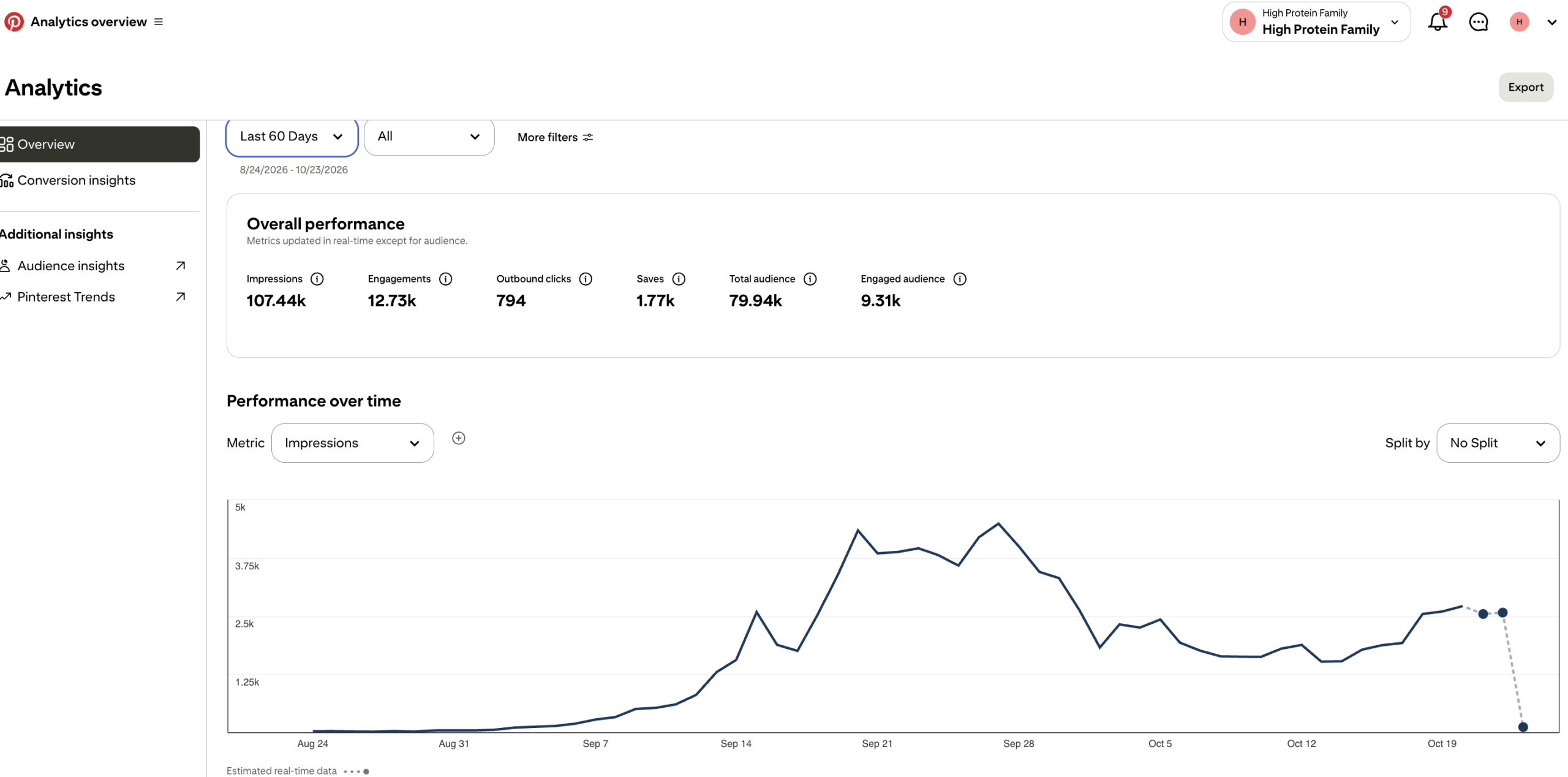
High Protein Family’s screenshot shows 107.44K impressions, 794 outbound clicks and 1.77K saves for August 24–October 23, 2026. The graph shows low activity near the beginning of that window and higher activity later.
I grew the account from scratch, but the window isn’t proof of its launch date. It would be misleading to turn it into a claim that every new account should reach the same numbers within sixty days.
Jennifer – Home Decor and Design provides another example: 183 outbound clicks, up 422%, for September 22–October 22, 2026 compared with the preceding 31 days.
The percentage and the count belong together. A large increase from a smaller starting point can be encouraging without implying a huge traffic volume.
For a developing account, the most useful question may be which content is beginning to connect. That helps decide what deserves another variation or a better destination page.
A large cumulative result says little about what a new account should do next week. The reporting period, existing content and account history matter. I’d use my own baseline to assess progress.
A fall in one metric is a reason to investigate, not immediate evidence that the whole strategy failed. I’d check the dates, filters, recent publishing and destination links before deciding what to change.
A compelling Pin that leads to a thin or mismatched page creates a poor experience. I’d rather promote fewer worthwhile destinations than make a large batch of promises the site doesn’t keep.
Account-level screenshots don’t isolate causes. I can use observations to form a hypothesis and choose a test without pretending that a chart proves why every change happened.
| Stage | Work to complete | What you should have afterward |
|---|---|---|
| Foundation | Review the site, audience, account and content inventory. | A clear starting point and a small destination list. |
| Research | Map relevant language and reader situations to the destinations. | A practical topic and creative plan. |
| Creative | Build accurate, readable Pins with distinct angles. | An initial batch that can be reviewed and scheduled. |
| Publishing | Check links, record the work and maintain the schedule. | A consistent process and a record of what went out. |
| Review | Check available metrics and choose the next test. | A short set of decisions rather than a dashboard recap. |
The stages can overlap. Required access, content readiness and feedback affect timing. This is a way to organize the work, not a promise that a new account will produce a particular traffic total by month-end.
DIY can make sense if you have useful content, time for research and creative work, and a willingness to review performance consistently. The important question is whether you can maintain the whole process—not simply whether you can design a Pin.
If the account needs a foundation, Pinterest account setup may be the right starting point. If you already publish but don’t know what is holding the account back, an account audit offers a focused review.
For specific questions you want to work through live, there’s a $97, sixty-minute strategy call. If the recurring research, design and publishing are the work you want off your plate, consider ongoing management.
I’ve grown all seven channels in the portfolio from scratch. Their results demonstrate my experience; they don’t establish a universal outcome or growth schedule. Your content, implementation and audience response will affect the result.
I wouldn’t use the same content plan for every niche. The reader’s questions, the destination pages and the visual format should guide the work. A common process can support different topic and creative decisions.
There isn’t a fixed threshold I’d apply to every business. Start by assessing whether you have enough useful destinations to support the workload you’re considering. If the content is not ready, publishing more Pins may not be the next priority.
Use both in context. Impressions help explain distribution; outbound clicks are more directly connected to traffic toward your destinations. Saves provide another signal. Website tracking is needed to understand what happens after the click.
Choose a worthwhile destination and a specific reader problem. Then work outward: relevant language, a clear Pin promise, readable creative, checked links and a manageable publishing process.
My Pinterest management plan is $497/month. It includes thirty new branded Pin designs, up to ninety scheduled placements, keyword research and content priorities, monthly reporting, a short recorded review and email support for one Pinterest account and one website.
The initial commitment is three months, billed monthly ($1,491 total), then month-to-month. Initial account review and priority profile and board improvements are included. A new account build, extensive setup, articles, videos, ads and website work are separately scoped.
Send me your website and goals for a free management inquiry. You don’t have to purchase a strategy call first. We’ll start by deciding whether the scope fits the content you have and the help you need.